
Answer each question correctly for a chance to win free registration for the NYC ASM Spring Meeting 2026!
Photo credit: Dr. Alex Jaramillo Cartagena, Dr. Ashton Creasy
| An 18-year-old patient originally from Haiti with acute myeloid leukemia (AML) was admitted to the hospital to receive ongoing consolidation chemotherapy (cytarabine). Eighteen days into admission, the patient presented with mild headache, rigors and chills, fever (102.7 °F), and low blood pressure (93/56 mm Hg). The patient was transferred to the intensive care unit (ICU) and rapidly improved on vasopressor support, steroids, and IV antibiotics.
Still neutropenic, there was fever recrudescence 10 days after initial presentation along with headache, chills, abdominal pain, and nausea. |
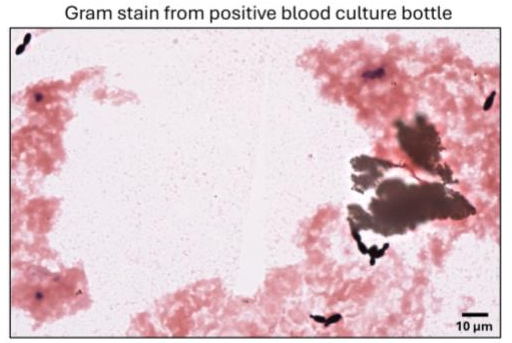 |
| Question 1: A single aerobic blood culture bottle (blood from central venous catheter) turned positive from specimens collected during this period. What type of microorganism was recovered from the blood? a) Gram-positive cocci b) Gram-negative bacilli c) Yeast/Yeast-like cells d) Gram-negative diplococci e) Gram-positive rods f) Staining artifact |
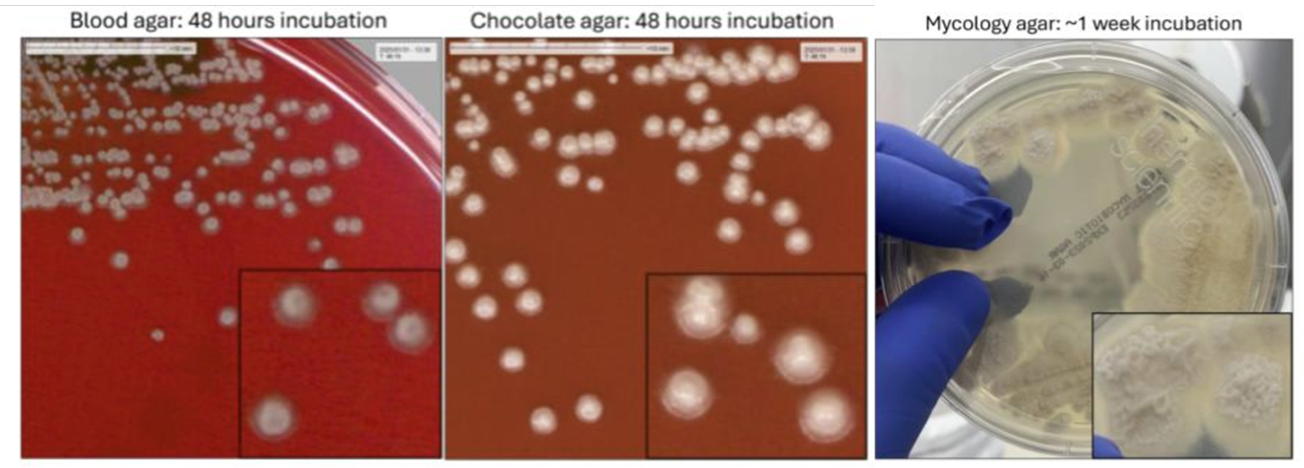 |
| Question 2: The organism was cultured on enriched and mycology-specific agar, respectively. What type of organism is this?
a) Yeast b) Yeast-like fungus unable to form true hyphae c) Yeast-like fungus able to form true hyphae d) Mold |
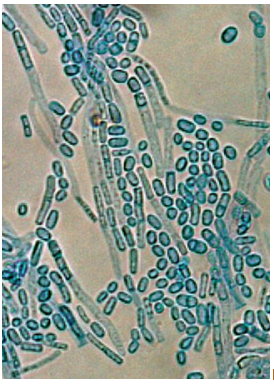
| Upon lactophenol blue preparation, the organism appeared as shown in below image. Dimorphic fungi was ruled out and the organism was Identified by MALDI-ToF as ________. The patient was placed on appropriate treatment, and the central line was removed with subsequent blood cultures negative. Unfortunately, the patient continued to have high grade fevers, abdominal pain, and new lesions (seen in the liver, spleen, kidney, and abdomen wall), with escalation to altered mental status and encephalitis. Brain MRI showed microabscesses suspicious for an infectious process. Serum cryptococcal antigen testing showed results of 1:160, 1:40, and 1:5 over 3 days. Cerebrospinal fluid (CSF) cryptococcal antigen testing performed on undiluted and diluted CSF was negative. CSF stains and cultures were negative. |
 |
| Question 3: What is the likely clinical interpretation from the collective diagnostic testing results?
a) The patient has cryptococcal meningitis. b) The patient has disseminated trichosporonosis. c) The patient has both A. and B. d) The patient’s condition can be explained by non-infectious causes. |
| SUBIT ANSWERS BELOW
|